Purpose-built cooling for tight plant spaces
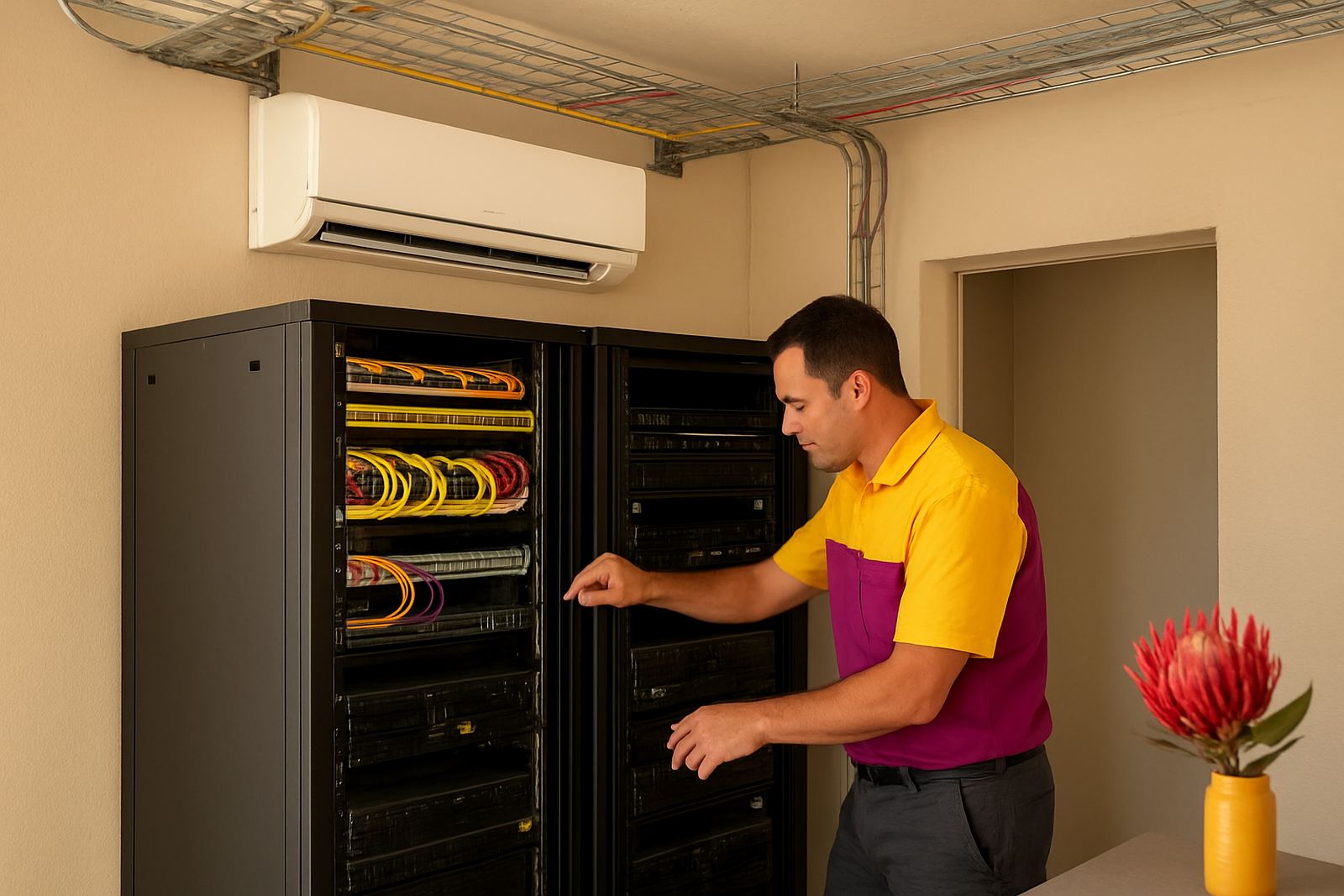
Server room aircon is made for small enclosed rooms that carry a steady internal heat load from equipment, UPS units, routers, monitors and control panels. It is not the same as a standard comfort aircon in a reception area. The target is stable room temperature, better humidity control and fewer nuisance shutdowns when the load-shedding cycle changes or the room has limited ventilation.
For many Western Cape sites, the need starts in a broom-size IT room, a security room, a shop back office, or a pump and controls room on a farm. In summer, a closed room can climb fast. In winter, damp coastal air can bring condensation and corrosion. A correctly sized unit helps keep the space dry, cooler and easier to manage day after day.
Sizes and options for small technical rooms
We match the cooling duty to the heat being generated, the room size, the insulation and the amount of fresh air leakage. A room with a few network cabinets needs a very different setup to a control room that runs all day. Where needed, we can advise on split systems, compact wall units or higher-capacity units for rooms with continuous heat gain.
- Small rooms: about 10 to 18 m2 with light equipment loads
- Medium technical rooms: about 18 to 35 m2 with cabinets, UPS or control gear
- Higher-load rooms: rooms with dense equipment, limited airflow or hot roof exposure
- Single-phase or three-phase supply, depending on the unit size and site supply
- Options for basic temperature control or tighter setpoint control where the application needs it
We also look at where the indoor unit can throw air properly, so the cold air is not short-circuiting straight back to the return. Poor air movement is one of the common reasons a room looks cooled but still runs hot at the top of the rack.
Where it works best in the Western Cape
Server room aircon is used wherever a small room carries something the business cannot afford to lose. That includes retail stock offices, weighbridge rooms, security control points, municipal interfaces, borehole and irrigation controls, and small server cupboards in commercial buildings. It is also practical on farms where control equipment sits in a compact room with limited airflow and dust around the site.
From Cape Town and Montague Gardens to Stellenbosch, Paarl, Malmesbury and Vredenburg, we see the same pattern: small room, low air volume, high heat build-up, and little margin for error. In coastal areas, the extra moisture in the air can make regular servicing just as important as the initial installation.
- Shop offices and back rooms
- Security and monitoring rooms
- Farm control rooms and pump rooms
- Small server cupboards and comms spaces
- Technical rooms with switches, inverters or battery gear
Installation, drainage and electrical needs
Good installation is about more than hanging a unit on the wall. The room must allow proper air circulation, a clean drainage route, safe cable routing and enough clearance for future maintenance. Where the room is sealed, we check for pressure issues and hot spots. Where the site is dusty, we make sure the unit can be cleaned easily and that filters are accessible without disturbing the equipment.
Power supply must suit the machine. Smaller units may run on single-phase power, while larger cooling loads can call for three-phase supply. If the site has frequent load-shedding or generator changeovers, it is worth checking start-up current, breaker size and the stability of the supply. A room that trips once can still take damage from heat before anyone notices.
Drainage also matters. Condensate must move away safely and not drip back into equipment or onto walls. In a humid coastal area, we take extra care with corrosion points, mounting hardware and pipe runs. Gas line length, flare quality and insulation all need to be right, otherwise the system loses performance and starts short cycling.
Servicing that keeps the room steady
Server room aircon should not be left until it fails. Planned maintenance helps keep temperatures steady and cuts down on emergency call-outs. We check filters, coils, drain lines, fans, electrical connections and refrigerant performance. We also look for airflow restriction, dust build-up and any sign that the room has changed after a new cabinet or more equipment was added.
For businesses that cannot afford downtime, a maintenance contract is usually the simplest route. It keeps the service dates on schedule and gives you a single point of contact for call-outs, leak detection, coil cleaning, drain clearing and temperature logging. If the room is critical, we can set up seasonal start-up and shutdown preservation around summer heat or periods when the site is not in full use.
- Filter cleaning and coil washouts
- Drain clearing and condensate checks
- Refrigerant leak detection and pressure checks
- Temperature logging for high-risk rooms
- Seasonal checks before summer and before winter shutdowns
Regular servicing also helps spot small issues before they turn into a complete stop. A blocked drain or a dirty coil may seem minor, but in a closed room the temperature can rise fast, especially when the system is already carrying a full load.
What to check before you place an order
Before you order server room aircon, it helps to have a few site details ready. That lets us size the system properly and avoid guesswork. If you are unsure, send photos and the room measurements and we can work from there.
- Room length, width and ceiling height
- Number of racks, cabinets, UPS units or control panels
- Current heat sources, including printers, monitors or battery gear
- Power available at the site, single-phase or three-phase
- Where the outdoor unit can be placed safely and with good airflow
- Any coastal exposure, dust, heat or load-shedding concerns
It also helps to know whether the room is always occupied, whether doors open often, and whether there is any fresh air intake that might bring in dust or humidity. Those details change the cooling load more than many people expect. If the room already struggles, we can assess whether the best fix is a dedicated unit, an upgrade, or a maintenance plan with closer checks.
Western Cape support from a local service team
Kenny Cape West has been supporting refrigeration and aircon work since 2011, with a base in Montague Gardens and service reach across Cape Town, the Winelands and the West Coast. Morne Jacobus van Wyk leads the business, with support from Anele Mbeki, Charlene Adams, Ruan Smit, Lutho Ndlovu and Bianca Petersen. That means you are speaking to people who handle call-outs, servicing and practical site work every week, not just taking a message and passing it on.
If your server room, control room or small equipment room is running hot, we can assess the site, size the cooling correctly and keep it maintained. For call-outs, maintenance contracts or installation enquiries, email callouts@kennycapewest.co.za.
Key facts
| Cooling type | Dedicated small-room split aircon for heat-sensitive equipment spaces |
|---|---|
| Typical room size | About 10 m2 to 35 m2, depending on heat load and insulation |
| Power supply | Single-phase or three-phase, subject to unit size and site supply |
| Temperature control | Fixed setpoint or tighter control, depending on the application |
| Key checks | Airflow, drainage, refrigerant charge, electrical supply, filter condition |
| Service coverage | Cape Town, Montague Gardens, Stellenbosch, Paarl, Malmesbury, Vredenburg |