Built for daily entry into chillers and freezers
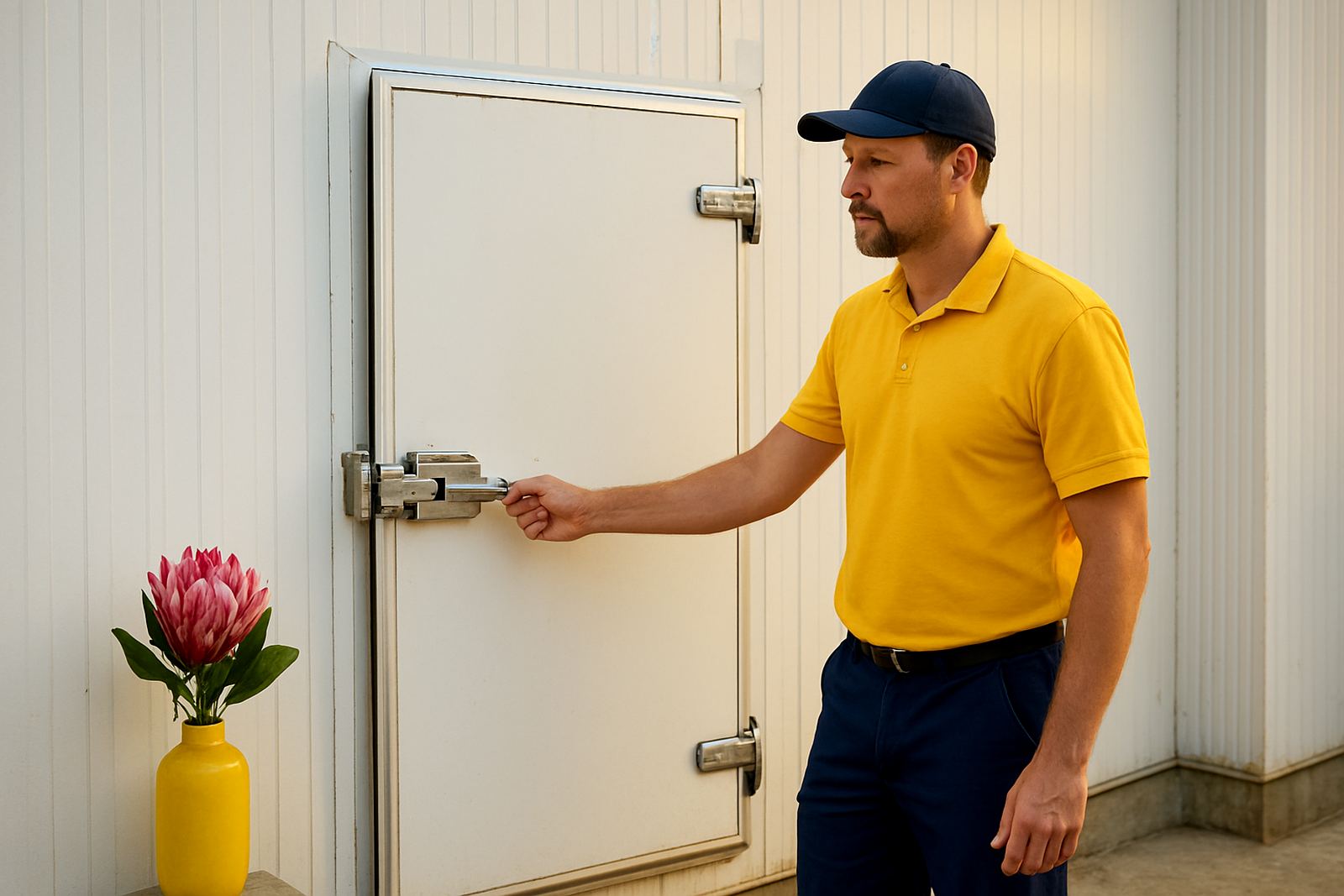
A hinged cold room door is the personnel access point on a cold room. It is made to open and close many times a day, then close down hard against a gasket so the room holds temperature. In a chiller it helps keep product at the right cool range, while in a freezer it helps stop frost build-up, warm air ingress and ice on the floor near the threshold.
These doors are used on meat rooms, produce stores, dairy holding rooms, farm packhouses and small retail back rooms. Around Cape Town, the Winelands and the West Coast, the big issue is often not only cold loss but humidity, salty air and dusty traffic through the building. A good door has to handle all three. If the leaf, frame and latch are not set right, you end up with ice on the seal, a hard close and extra work for the refrigeration system.
The door is normally supplied as a complete personnel access unit with frame, hinged leaf, locking gear and compression seals. Some rooms need a simple interior push lock, others need an external keyed handle, and some need emergency release hardware for safety. The right choice depends on how often staff enter, whether trolleys pass through, and how cold the room runs.
Sizes, thicknesses and practical options
Most hinged cold room doors are ordered to suit the opening size on site, because the frame has to match the room panels and the floor detail. Standard clear openings are often around 700 mm to 1000 mm wide and 1800 mm to 2100 mm high for personnel use, although larger custom openings are common where staff carry crates or where the room layout is tight. The leaf thickness usually follows the room insulation spec, often 75 mm, 100 mm or 120 mm, with thicker panels used for freezers and rooms that stay open to the outside air for long periods.
For a freezer room, the door may need a heated frame or threshold detail to reduce ice bridging, depending on the room design. On the coast or in damp inland conditions, that detail matters a lot. A door that closes well in winter can start to stick in summer if the room is not installed square, or if the gasket has taken a set. We check the opening, floor level and panel line before ordering, because a few millimetres out can cause maintanance headaches later.
Typical options include:
- Left-hand or right-hand hanging, depending on traffic flow
- Internal and external handles with safety release from inside
- Vision panel for busy areas where staff need to see movement first
- Lockable hardware for stock control and after-hours security
- Low-threshold or flush-threshold details where trolleys and pallets pass nearby
Where it suits best on farms, shops and packhouses
This type of door suits places that need a smaller access point rather than a sliding industrial door. It is a good fit for a butchery back room, a bottle store cold store, a fruit holding room, a milk room, a flower cooler or a farm packing area. In many Western Cape sites, staff only need one person in and out at a time, so a hinged door gives enough access without taking up extra wall space.
It also works well where the room is tucked into an existing building, because the door swing can be planned around the corridor or prep area. If the space is narrow, we look at whether the door should open inward or outward and how it affects the evacuation route. If forklifts, trolleys or pallet jacks pass close by, the door position needs to be set so it does not get knocked, because even a small bend in the frame can break the seal.
For farms, the benefit is simple: a personnel door is easier to use in an everyday working room, and it is cheaper to service than a larger access system. In retail, the same door helps reduce cold loss when the store is getting deliveries, checking stock or doing end of day clean-up.
Installation details that keep the seal working
A hinged cold room door does not need a power supply for normal operation, and it does not use gas. What it does need is a square opening, a clean floor finish and proper fixing into the insulated wall or panel system. The frame must sit true, the hinges must carry the weight evenly, and the latch must pull the seal in all the way around. If the installer rushes that part, the room may still cool but it will work harder than necessary and pull moisture in every time someone opens it.
When we install or replace a door, we check the door swing, sill detail and seal compression. On freezer rooms, we pay close attention to the threshold and any heater detail specified by the room builder. On older buildings, especially where there has been repeated moisture or earlier repairs, the opening may need extra packing or a small rebuild before the new door goes in.
Power is only relevant if the room design includes a heated frame, anti-sweat element or monitoring device. Those items should be connected and tested by a competent person, then checked during the first few days of operation. If the room is tied into a temperature logging system, the door should close cleanly enough that the logger does not show unnecessary spikes after routine access.
Care, servicing and common wear points
A cold room door lasts longer if it is cleaned and checked as part of the normal maintanance routine. Gaskets should be wiped clean, hinges kept aligned and the latch checked for smooth pull-in. In dusty towns, on farms and on busy loading bays, grit can build up at the threshold and stop the seal from closing properly. In coastal air, metal parts can pit sooner, so a regular visual check is worth the effort.
Watch for these warning signs:
- Door does not close without a hard shove
- Ice or condensation appears around the frame
- Gasket is split, flattened or pulling away
- Latch feels loose or does not draw the leaf tight
- Floor near the door is wet, sloped or lifting the seal
If a room is showing repeated frost at the doorway, it may not be only the seal. The compressor cycle, defrost setting, evaporator fan and room traffic all play a part. Kenny Cape West handles cold room servicing, leak detection, coil cleaning and drain clearing across Cape Town, Montague Gardens, Stellenbosch, Paarl, Malmesbury and Vredenburg, so we can check the door as part of a full room inspection rather than guessing at the cause.
What to check before you place an order
Before ordering a hinged cold room door, measure the clear opening carefully and confirm whether the room is a chiller or freezer. You also need to know which side the hinges should be on, how much swing space is available and whether the room needs emergency release hardware. If the existing door is being replaced, send photos of the current frame, latch, threshold and wall build-up, because that usually shows up the fitting challenges early.
Useful details to confirm include the internal clear width, the clear height, the wall thickness, the panel type, the floor finish and the direction of traffic. If staff carry crates or use a trolley, allow for enough width so people are not scraping the frame every day. If the room sits in a hot, humid or dusty part of the site, ask about a higher grade seal and regular service intervals.
For new projects, we can align the door with the rest of the cold room work and maintenance plan so the installation does not cause extra downtime. For repairs, we can inspect whether the issue is the door itself, the frame, the floor detail or the refrigeration system running too hard because of air leak. That saves time and gives a clearer fix.
Key facts
| Door type | Hinged personnel access door |
|---|---|
| Use | Chiller rooms and freezer rooms |
| Typical clear opening | 700 mm to 1000 mm wide, 1800 mm to 2100 mm high |
| Leaf thickness | 75 mm, 100 mm or 120 mm depending on room spec |
| Hardware | Hinges, latch, compression seal, optional safety release |
| Install needs | Square opening, level floor, no power required unless heated frame or monitoring is specified |