What a ceiling suspended unit is and where it fits
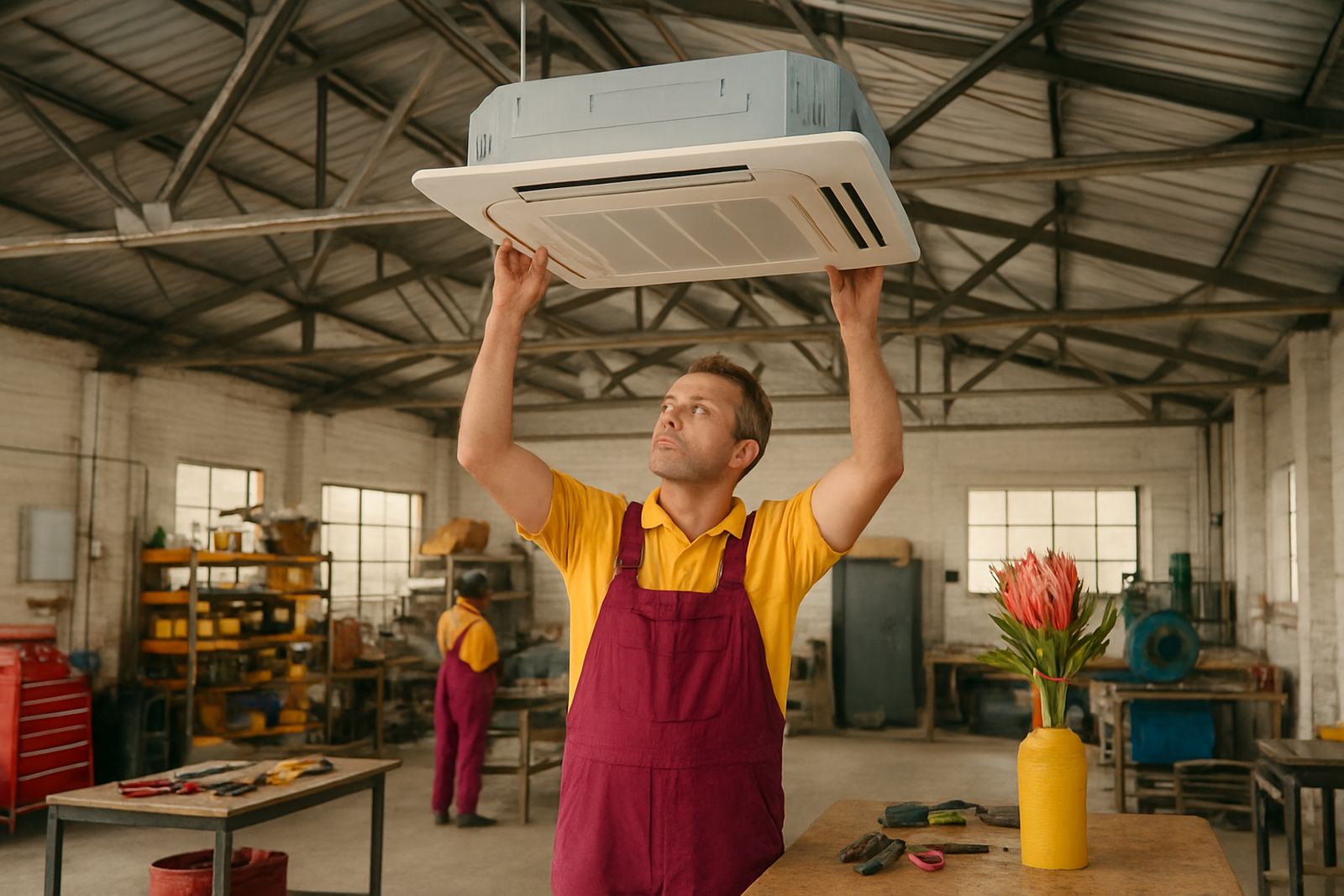
A ceiling suspended unit is an indoor air conditioning unit mounted high on the wall or just below the ceiling, with airflow directed along the length of the room. Because it sits up out the way, it keeps floors clear for stock, tables, workbenches and people moving through the space. That makes it a practical choice for long rooms, open-plan areas and sites where a normal wall unit would struggle to push air far enough.
We fit and service these units across Cape Town, Montague Gardens, Stellenbosch, Paarl, Malmesbury and Vredenburg, including shops, schools, pack houses, sheds and offices on farms. In the Western Cape, temperature control matters during hot inland afternoons and damp coastal spells, so the unit needs to suit the room size and the actual use, not only the name on the box.
Common applications include:
- Church halls and function rooms
- Workshops and repair bays
- Long retail aisles and back-of-house areas
- Farm offices, tasting rooms and storerooms
- Light industrial spaces with higher ceilings
Typical sizes and operating options
Ceiling suspended units are available in a range of cooling capacities, usually from about 36 000 BTU up to 96 000 BTU, with larger duty models for bigger rooms. The right size depends on ceiling height, glass area, people load, heat from equipment and whether the room is insulated. A unit that is too small will run hard all day and still leave hot spots, while one that is too large may short cycle and waste power.
Most units can be supplied for cooling only or reverse cycle operation for heating in winter. That helps in the Winelands and West Coast areas where mornings can be cold, then warm up fast by midday. We also check whether the room needs a single unit or more than one so the air is spread properly. Sometimes two mid-size units work better than one oversized unit, especially in long rooms with partitions or storage sections.
Options may include:
- Manual or remote control operation
- Auto swing louvers for wider air spread
- Fresh air connection on selected setups
- Drain pump where gravity drain is not possible
- Sleep, timer and setback functions for after-hours use
Installation requirements on site
These units need a solid fixing point, correct clearances and a route for the piping, drain and cable back to the outdoor unit. The indoor unit is only one part of the system. Outside, the condenser must sit where it has clean air and enough space around it for heat rejection. If the outdoor side is squeezed into a corner or left in full sun with no airflow, the whole system suffers.
For new installs we look at electrical supply, pipe length, ceiling height and how the condensate will drain. On some properties the power supply is steady, on others load-shedding and voltage dips mean the installation should be set up carefully with suitable protection and correct cable sizing. If the room is in a coastal zone, we also consider corrosion from salty air and choose a location that will not rust out too quickly.
- Allow clear space around the indoor unit for service access
- Keep the drain route short and properly sloped where possible
- Confirm the outdoor unit position before pipe work starts
- Check that the building structure can take the weight
Power, pipework and refrigerant matters
Ceiling suspended units run on refrigerant pipework linked to an outdoor unit and require a proper electrical connection from a qualified installer. Pipe diameter, pipe length and refrigerant charge must match the system size. If the pipe run is too long, or the charge is not set correctly, cooling drops and compressor strain goes up. That is when clients start calling about poor performance, noisy operation or icing on the coil.
We also check that the electrical isolator, breaker size and control wiring suit the unit selected. In many Western Cape buildings the problem is not only the aircon itself, but a tired connection, loose contactor or a drain line that has been blocked by dust and algae. On dairy rooms, packhouses and kitchens, temperature recovery after doors open is important, so the refrigerant circuit and fan speed need to be matched to the job.
If an existing room is being converted from another cooling type, we can assess whether the old pipework can be reused or should be replaced. Reusing old lines without a pressure test is a bad idea, because hidden leaks and oil contamination cause repeat faults.
Servicing that keeps air moving and drains clear
Ceiling suspended units work hard in dusty or humid conditions, so planned maintenance is worth doing. Filters clog, coils collect dust, drain lines silt up and fans lose efficiency if they are left too long. In the Cape Town metro and out towards Malmesbury, fine dust and airborne dirt can build up quicker than people expect, especially in rooms with open doors.
Our service approach includes coil cleaning, drain clearing, leak detection, temperature logging and seasonal start-up checks. For sites with higher risk stock or process control, we can set up maintenance contracts so the unit is checked before summer and again before winter. That helps catch small faults before they become a full breakdown on a Friday afternoon, which is never ideal.
- Clean return air filters regularly
- Check condensate drains for blockages and spills
- Inspect pipe joints for oil staining or frost
- Make sure the remote sensor is reading the room properly
- Record temperatures where product safety matters
What to confirm before you place an order
Before ordering, it helps to have the room dimensions, ceiling height, insulation details and what the space is used for during the day. We also need to know whether the room has glass, heat-producing machinery, high occupancy or doors that stay open for long periods. A loading bay or workshop in Paarl will need a different setup from a showroom in Stellenbosch, even if the floor area looks similar.
Please check the following before we quote or schedule work:
- Room length, width and ceiling height
- Whether the unit is for cooling only or heating too
- Power supply available on site
- Distance to the outdoor unit position
- Drainage route for condensate water
- Any access limits, ladders or working-at-height issues
If the space is for cold-sensitive stock or temperature-controlled process work, tell us upfront. We can advise on setpoints, temperature logging and whether a ceiling suspended unit is the best fit or part of a bigger refrigeration setup.
Local support from Kenny Cape West
Kenny Cape West is based in Montague Gardens, Cape Town and has been working in refrigeration and aircon since 2011. Our team handles call-out repairs, planned maintenance, cold room work and aircon servicing across the Western Cape. That includes emergency breakdowns, shutdown preservation, seasonal start-up and fault finding on systems that have been under strain from heat, dust or power interruptions.
For ceiling suspended units, we can help with selection, installation, leak detection, coil cleaning and after-sales servicing. If your room is in the Cape Town area or further out in the Winelands or West Coast, send the room size and a few photos and we will advise on the right capacity and install layout.
Email us at callouts@kennycapewest.co.za for support, quotations or a service booking.
Key facts
| Unit type | Ceiling suspended indoor aircon unit |
|---|---|
| Typical capacity range | 36 000 BTU to 96 000 BTU and larger duty options |
| Best room types | Halls, workrooms, shops, farms and deep open spaces |
| Installation needs | Solid fixing point, drain route, electrical supply and outdoor unit |
| Service checks | Coils, filters, drains, refrigerant pressure and controls |
| Coverage area | Cape Town, Montague Gardens, Stellenbosch, Paarl, Malmesbury, Vredenburg |