What a blast chiller does in daily food handling
A blast chiller is built to pull heat out of cooked product fast, then hold that product at a controlled low temperature until it is ready for storage or use. That matters in bakeries, butcheries, farm kitchens, caterers, delis and packed-food rooms where product quality and food safety both depend on getting through the danger zone quickly. On a hot Cape Town summer afternoon or during load-shedding recovery, slow cooling can cost stock, labour and time.
The unit uses a strong refrigeration circuit and high airflow to move heat off trays, pans or shallow containers. It is not the same as a normal fridge or upright freezer. A standard cold room keeps product cold, but a blast chiller is made for fast pull-down after cooking, par-cooking or hot packing. Some units also offer a shock-freeze stage for items that need to be frozen without large ice crystals forming.
For food businesses in the Western Cape, that means better control over soup, sauces, pastry, cooked meats, meal prep and temperature-sensitive stock. It also helps with batch production because you can cook ahead, chill correctly and portion later without rushing service.
Sizes, tray formats and the options that matter
Blast chillers come in compact counter units, upright cabinet units and larger pass-through or roll-in styles. The right choice depends on daily volume, tray size and whether the unit is used for a small prep room or a full production kitchen. A 3 tray or 5 tray unit may suit a café or farm deli, while larger operations often need 10 to 20 tray capacity or more. Some models take GN pans, others suit bakery trays or mixed racks.
When comparing options, look at usable capacity rather than only the outside size. Air movement, tray spacing and internal chamber depth affect how evenly product chills. If trays are packed too tight, cooling slows down and the unit works harder. For sites in Malmesbury, Paarl or Stellenbosch where production is often tied to peak harvest or visitor periods, the capacity needs to match the busiest day not the average day.
- Tray formats: GN pans, bakery trays or mixed rack layouts
- Cooling modes: soft chill, hard chill and shock-freeze on some models
- Controls: digital temperature display and timed cycle settings
- Door type: solid single door, split door or pass-through configuration
- Build: stainless steel interiors are common for food areas
Where it suits best in the Western Cape
Blast chillers are used in places where food is made in batches and then held for later service. That includes retail food shops, farm kitchens, caterers, school kitchens, canteens, boutique butchers and bakeries. They also suit packhouses or chilled prep rooms where portioned product must be cooled before storage or dispatch. In coastal towns like Cape Town, Montague Gardens and Vredenburg, humidity can increase the load on refrigeration equipment, so correct siting and airflow around the cabinet matter.
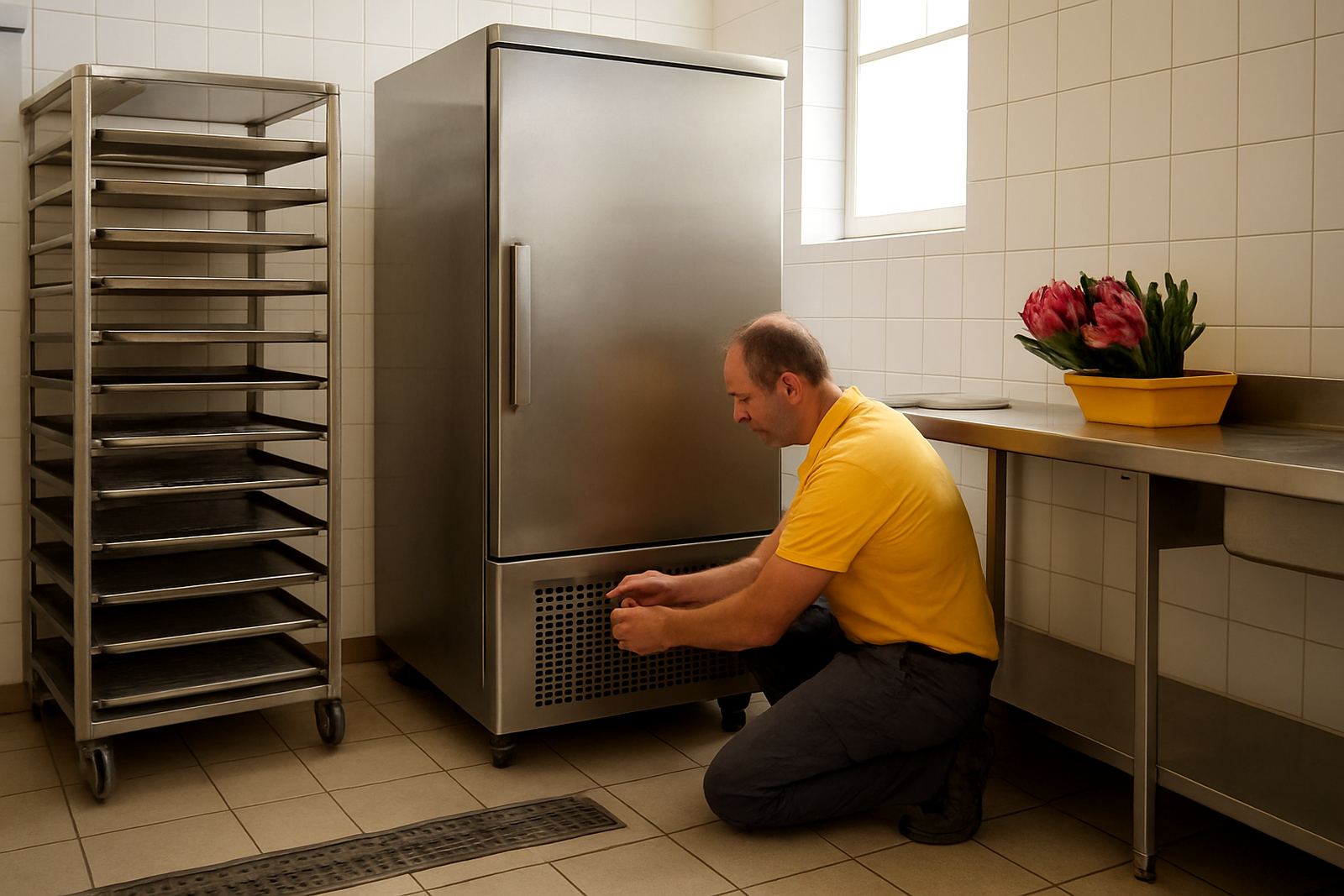
The unit needs a clean, level position with enough clearance for intake and discharge air. It should not be pushed hard against a wall or parked beside ovens, dishwashers or fryers. Heat from other equipment increases running time and can shorten component life. If the room is small, a site check helps determine whether extraction, ventilation or extra clearance is needed.
- Good fit for cooked meal prep and batch cooking
- Useful in bakeries for cream, custard, pastry and sponge work
- Suitable for farms handling dairy, fruit prep or ready-made meals
- Helpful where stock must be cooled before overnight storage
Installation, power and drainage basics
Most blast chillers need a dedicated electrical supply and correct breaker protection. Smaller units may run on standard single-phase power, while bigger cabinets often need three-phase supply. The exact load depends on cabinet size, compressor size and whether the unit includes a shock-freeze function. Before ordering, check the available supply at the site so the unit is not installed only to trip out under load.
Good installation also includes drainage for condensation and easy cleaning access around the unit. In busy kitchens, a blocked drain line can cause water pooling, odours and slip risks. If the unit is near a prep area, make sure there is enough space for opening doors fully and removing trays without scraping walls or other equipment. For farms and remote sites, we also check access for future servicing because a unit that is hard to reach becomes expensive to keep in use.
Some blast chillers are fitted with remote refrigeration components, while others are self-contained. Remote systems can suit larger rooms or warmer spaces, but they need proper pipe work, refrigerant charge and control settings. A poor installation can lead to long pull-down times and higher power use. It is worth getting the electrical and mechanical checks done before the first load goes in, not after the first fault callout.
Care, cleaning and scheduled servicing
Blast chillers need regular cleaning because grease, flour dust and food vapour build up on coils, fans, drain pans and door seals. If the coil is dirty, airflow drops and the pull-down cycle slows. If the drain is blocked, water may sit inside the cabinet and lead to smell or ice build-up. In coastal areas, salt air can also affect condensers and fixings, so a regular service is worth it even when the unit seems to be working fine.
Our planned maintenance work covers coil cleaning, drain clearing, leak detection, temperature logging and start-up checks after shutdown periods. We also check controls, door seals, fan operation and compressor performance. If a unit is used seasonally, shutdown preservation is important so the cabinet can be stored clean and restarted without avoidable faults. A short service visit is cheaper than losing a batch of product because the unit cooled slowly or ran warm.
- Clean coils and fans on a planned cycle
- Check temperature pull-down against the set point
- Inspect seals, hinges and door closers
- Confirm drainage is free and flowing
- Log temperatures where food safety records are kept
What to confirm before you place an order
Before you order a blast chiller, confirm the product volume, the tray size, the daily number of cycles and the room conditions where it will sit. If the unit is too small, it will take too long to chill each batch. If it is too large for the site, it may use more space and power than needed. You should also check whether the load will be cooked food, raw prep, packaged stock or mixed product, because that affects the cycle settings and the temperature targets.
It helps to know whether you need chill only or chill plus freeze. Some businesses only need safe pull-down to chilled storage. Others need a unit that can move product into frozen storage after the first stage. Also confirm the electrical supply, whether the floor is level enough, and whether there is enough access for delivery through doors, passages or narrow plant rooms. We often see jobs delayed because a cabinet fits the room but not the route in.
If you are unsure, send the site details, power supply and the type of product you handle. That allows a proper recommendation instead of guesswork. Kenny Cape West can also assist with fitting, maintenance contracts and repair support after installation, so the unit stays in service when the pressure is on.
How Kenny Cape West supports blast chiller units
We work from Montague Gardens and support sites across Cape Town, Stellenbosch, Paarl, Malmesbury and Vredenburg. Our refrigeration team handles call-out repairs, maintenance contracts, cold-room work, aircon servicing and temperature control checks for shops and farms. If a blast chiller is cycling too slowly, icing up or failing to reach temperature, we trace the fault from the electrical supply through to the refrigeration circuit and operating controls.
For businesses that rely on chilled product every day, we can set up a service plan with routine inspections, coil cleaning and temperature logging. That keeps the equipment honest and makes it easier to spot a developing fault before it turns into a full breakdown. If a unit is installed in a busy prep room or near coastal air, the right servicing interval can make a real difference to running costs and downtime.
Key facts
| Product type | Blast chiller unit for rapid pull-down of cooked food and sensitive stock |
|---|---|
| Typical capacities | 3 tray, 5 tray, 10 tray and larger cabinet formats available |
| Temperature function | Chill cycles for rapid cooling, with shock-freeze on selected models |
| Power supply | Single-phase or three-phase depending on size and output |
| Construction | Food-grade stainless steel interior commonly used, with insulated cabinet panels |
| Installation needs | Level floor, ventilation clearance, drainage and correct electrical protection |