What an air curtain does at a busy doorway
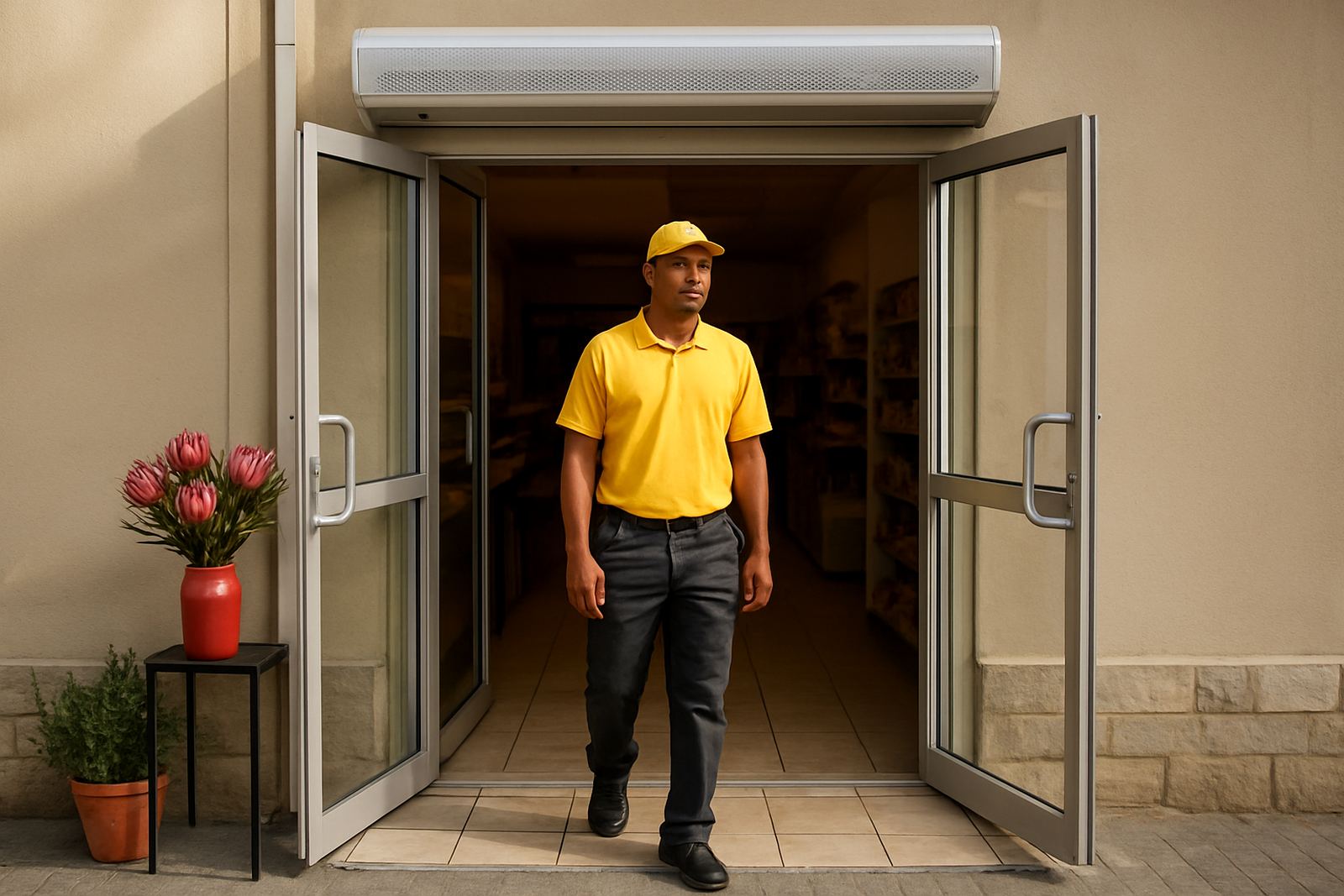
An air curtain fits above or beside a doorway and blows a controlled stream of air down or across the opening. The aim is to form a barrier that reduces warm air entry, helps hold in cooled air, and makes the space more comfortable for staff and customers. In the Western Cape, that matters on hot summer days, on windy Cape Town streets, and in coastal areas where damp air can push into chilled spaces.
It is not a substitute for a door that should stay closed all the time. It works best where people, trolleys or delivery traffic keep moving through the opening. That includes shop entrances, kitchen doors, cold room access points and farm packhouse doorways where every opening costs energy and lets dust in.
For businesses running refrigeration or air conditioning, a good unit can reduce the strain on the system and help steady the temperature. That can support product quality, lower complaint levels and make the room feel less draughty for the people working there.
Sizes, airflow patterns and control options
Air curtains are chosen to suit the width and height of the doorway, plus the amount of traffic passing through it. A narrow service door in Stellenbosch does not need the same output as a wide loading entrance in Montague Gardens, so the right size matters. Most units are selected to cover standard single or double doors, but larger openings may need more than one unit or a specially arranged install.
- Width: Common lengths cover single doors and double doors, with longer units used for wider openings.
- Throw: The air discharge must reach the floor or the required crossing point without blowing so hard that it becomes uncomfortable.
- Speed control: Useful for adjusting output on calm days, windy days or when the doorway is open less often.
- Heat option: Some sites use unheated units, while others need tempering for winter mornings.
- Mounting: Units may be fitted horizontally above the door or, on certain layouts, vertically at the sides.
We also consider the site conditions. High ceilings, strong cross winds, coastal corrosion, and doors that open all day all affect what should be supplied. On a farm outside Paarl, for example, dust control may be just as important as temperature control. In a shop in Cape Town, customer comfort and noise levels may matter more.
Where air curtains work best in the Western Cape
Air curtains are most useful where the doorway is a working point, not just a pass-through. We fit and service them in retail stores, food prep areas, warehouses, cold rooms, butchery spaces, bottle stores, packing sheds and farm stores. They are also helpful at front entrances where the door is left open during trading hours.
They suit sites where you want fewer flies, less dust, a more stable room temperature and less pressure on refrigeration equipment. Near the West Coast, salty air and wind can make a doorway harder to manage. In the Winelands, heat and repeated door opening can let warm air build up quickly. In both cases an air curtain can make the space easier to control.
- Shop entrances with steady foot traffic
- Cold room doors that open often during receiving and dispatch
- Packhouses and farm stores with dust or insect pressure
- Kitchen and prep room doorways
- Warehouses where temperature and comfort matter
We always check the door size, traffic pattern and the rest of the cooling setup before recommending a unit. The wrong size can waste power and still leave gaps.
Installation, power needs and site conditions
Most air curtains need a firm fixing point above the door and a suitable electrical supply. Depending on the unit, this may be a standard single phase connection or a site-specific electrical arrangement. We check available power before installation so the unit is matched to the supply and does not trip during busy trading periods or when load-shedding changes the operating pattern.
On certain sites, especially where doors are high or the opening is wide, the bracket layout and discharge angle matter as much as the unit itself. If the airflow is aimed badly, it can spill into the room or miss the doorway. That is why we measure the opening properly and set the unit for the actual height, not only the door frame on paper.
For cold room work, the setup may need close coordination with the refrigeration system so the air barrier supports the room rather than fighting it. In coastal areas we also pay attention to corrosion, cable protection and where moisture can collect. A unit installed too close to a wet area can need more frequent attention than one mounted in a dry corridor.
Care, servicing and signs it needs attention
An air curtain needs regular cleaning and inspection to keep the airflow even. Dust on the intake grille, blocked filters or a worn fan motor can reduce the air pattern and make the doorway feel open again. In food sites and farm stores, this can show up as more insects, more dust on product and more temperature swing near the entrance.
During maintenance we check the fan assembly, mounting points, control switches, wiring, airflow direction and overall condition of the unit. If the site runs alongside refrigeration equipment, we can include it in a planned maintenance schedule with coil cleaning, drain clearing and temperature logging where needed.
- Air feels weak or patchy at the doorway
- Unit rattles, vibrates or makes a change in sound
- Dust builds up quickly around the entrance
- Room temperature shifts when the door stays open
- Controls trip, fail to start or need repeated resets
Regular servicing helps the unit stay effective and can reduce small faults becoming a bigger repair. That is especially useful for shops in busy centres and farms where the doorway works hard every day.
What to check before you order an air curtain
Before ordering, measure the clear doorway width and the mounting height above the opening. Note whether the doorway is used by people only, or by trolleys, pallets and hand trucks too. If the opening is exposed to wind, or if the building has a strong through-draught, say so. Those details change the airflow requirement.
It also helps to know whether you need heating, whether the unit must run quietly, and what power is available on site. For a cold room entrance in Malmesbury, the priority may be temperature control and fast recovery. For a shop in Vredenburg, the focus may be customer comfort and keeping insects out. For a packhouse near Paarl, dust control and frequent opening times may be the main issue.
When we quote, we look at the door type, wall space, electrical supply and the service access needed for future cleaning. If the installation is tight, we will say so upfront rather than leave you with a unit that is hard to maintain later on.
Key facts
| Unit type | Doorway air barrier for shops, cold rooms, packhouses and service entrances |
|---|---|
| Typical mounting | Horizontal above the opening, with some sites using vertical side mounting |
| Size range | Selected to match single doors, double doors and wider working openings |
| Power | Site-dependent electrical supply, usually single phase on smaller units |
| Controls | On/off control with optional speed settings and heat control on selected models |
| Maintenance | Filter and grille cleaning, fan checks, wiring inspection and airflow testing |