Why an office can feel hotter than the set temperature
When a business says the aircon is on but the office still feels sticky, the fault is often not the thermostat alone. In summer, sun load through windows, people in the room, printers, computers and doors opening all day can push the space past what the system was sized for. A unit that worked fine in May can struggle in January once the afternoons climb into the thirties.
We see this often in Cape Town and the Winelands where older office layouts were changed over time. A meeting room becomes a storage area, a partition goes up, or a server cupboard starts dumping heat into the same zone. If the return air cannot move freely the system keeps running but the room still sits warm. That is when people start lowering the set point and making the problem worse.
- South-facing rooms can still overheat if the glazing is large or unshaded
- Small offices with many laptops and printers often build heat fast
- Closed doors and blocked return grilles reduce circulation
- Units that are slightly undercharged lose cooling capacity in hot weather
The most common service faults behind summer overheating
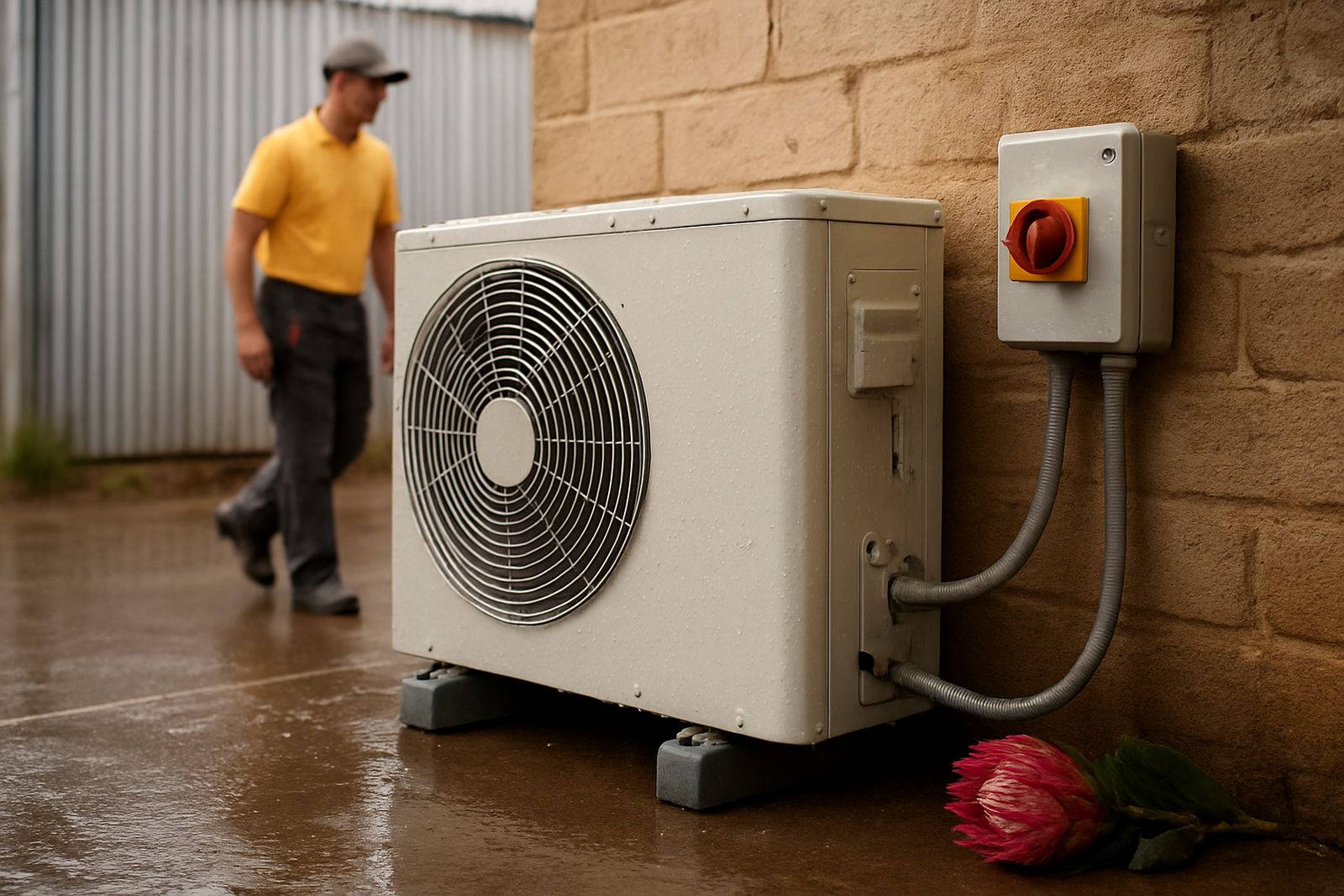
Dirty filters are only the start. We regularly find coils choked with dust, drain lines blocked by algae and indoor fans struggling because they have not been cleaned since the last shutdown. On coastal sites around Cape Town and Milnerton, salty air can also shorten the life of coils and electrical parts if maintenance is left too long.
Refrigeration pressure problems matter too. A small gas leak, a weak compressor capacitor, a faulty sensor or a restricted expansion valve can all reduce cooling output without the system stopping completely. The unit may switch on and off, blow cool for a few minutes, then fade. That is a common complaint in offices where load-shedding has also caused repeated starts and stops over summer.
- Dirty indoor or outdoor coils
- Blocked condensate drains causing water and mould smells
- Low refrigerant from slow leaks
- Damaged insulation on pipework
- Incorrect thermostat placement near heat sources
A proper call-out should check the full operating cycle, not just gas pressure. If the system is left to run in that condition, the electricity bill rises and the space still does not cool properly. Then staff begin opening windows for relief, which adds more hot air and dust.
Office layout changes can make a good system look bad
Many overheating complaints come from changes made after the original aircon design. A new reception counter, extra workstations or a glass meeting room can change the way air moves through the office. Even a filing cabinet placed under a supply register can throw off the room balance.
In a Paarl office we serviced recently, the director complained that the boardroom was always warmer than the rest of the building. The unit itself was fine, but a new partition had cut off the return path and the door closer was broken. Once we restored the airflow path and cleaned the coil the room held temperature properly again. It was a small fault, but it wasted a lot of time before anyone spotted it.
For businesses in older Western Cape buildings, it helps to treat aircon as part of the room setup, not a separate appliance. Heat sources, blinds, door use and occupancy all need to be considered. If the office plan changes, the cooling plan may need a review as well.
What maintenance should happen before peak summer
Planned maintenance is the cheapest way to avoid hot offices in December and January. A spring check gives enough time to sort out leaks, worn parts and blocked drains before the first real heat wave hits. It also helps businesses prepare for festive trading, when staff numbers and visitor traffic often go up.
For offices in Stellenbosch, Malmesbury and Vredenburg, we usually recommend a practical maintenance list rather than a long report that sits in a file. The goal is to keep the system working through the season, not just to tick a box.
- Clean indoor and outdoor coils
- Check refrigerant levels and look for leak signs
- Clear drains and test drainage fall
- Inspect controls, sensors and isolators
- Check fans, capacitors and electrical connections
- Test temperature logging where records are needed
This is also the right time for seasonal start-up. If a unit has been idle through winter, or only used lightly, it should be checked before full summer operation. A fast start-up after months of sitting can hide a fault until the hottest week of the year, which is never when you want a surprise.
Why some offices need more than one fix
Sometimes the answer is not another service visit but a mix of maintenance, aircon servicing and a small adjustment to the space. A unit may need cleaning, but the office may also need better shading, a different schedule for door use, or a review of how many people work in one zone.
For farms and remote offices around the West Coast, dust is often the big issue. Fine dust from yards, tracks and packing areas clogs filters and coils quicker than many managers expect. In those buildings, weekly filter checks during peak season can make a real difference. On the coast, humidity brings its own trouble, because damp air puts extra strain on drainage and can encourage smells if the drain line is not clean.
If the space is critical, such as an accounts office, client reception or server room, it is worth planning shutdown preservation too. That means protecting the system properly when the building is closed for holidays or when a section of the site is out of use. It sounds simple, but it can save a lot of trouble when everyone returns in January.
A local Western Cape example from a warm January week
A small office near Montague Gardens called us on a Thursday afternoon when the staff said the rooms were hotter by the hour. The aircon was running but the back office and a meeting room stayed uncomfortable. The outdoor unit was clean enough, but the indoor coil was blocked and the drain line had a partial choke. The system was trying to cool, yet the airflow was poor and moisture was building up inside the unit.
We cleaned the coil, cleared the drain and checked the controls. We also found that a cardboard box had been placed in front of a return grille during a storage shuffle, which was cutting the airflow. After the visit the office held temperature properly again. It was not one big failure, just three small ones adding up at the wrong time.
That is why summer overheating should be treated as a service issue first. In many offices the equipment is still there and still working, but it needs attention before the heat gets ahead of it.
How Kenny Cape West handles office cooling call-outs
Kenny Cape West works across Cape Town, Montague Gardens, Stellenbosch, Paarl, Malmesbury and Vredenburg on refrigeration and aircon call-outs, planned maintenance, leak detection and cold-room work. For office overheating we look at the full system, from coil condition and drainage to refrigerant performance and room airflow. If a building needs ongoing support, we can set up maintenance contracts that suit the site and the season.
Our team is led by Morne Jacobus van Wyk, with support from Anele Mbeki, Charlene Adams, Ruan Smit, Lutho Ndlovu and Bianca Petersen. If an office is running warm and staff are complaining, it is worth getting it checked before the next heat spike or power interruption makes it worse. A short inspection now can save lost time, unhappy staff and avoidable repair cost later.
- Email: callouts@kennycapewest.co.za
- Based in Montague Gardens, Cape Town
- Serving the Western Cape from the city to the Winelands and West Coast