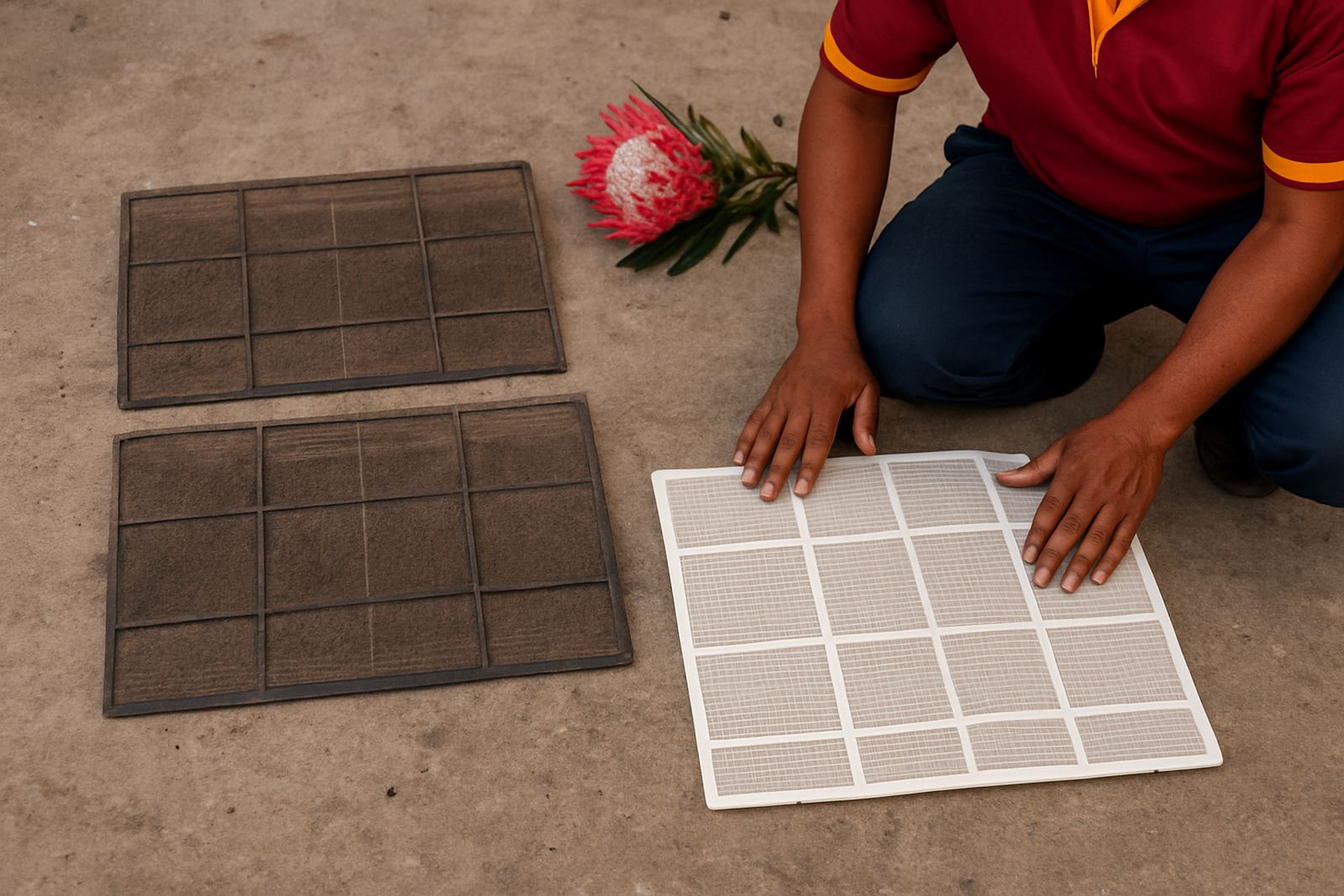
Why filter cleaning matters in daily use
An aircon filter is the first barrier between the room and the coil. When it loads up with dust, the unit has to pull air through a blocked surface, so the system uses more power and delivers less cooling. In a Western Cape summer, that extra strain shows quickly in shops, packing areas and offices where doors open all day.
Dirty filters also affect indoor air quality. People notice it as stale air, more dust on counters, and a unit that seems to run forever without reaching temperature. In some sites the filter is the easiest part to forget, yet it has a direct effect on call-out frequency and wear on the rest of the system.
How often filters usually need attention
There is no single number that suits every site, but these are practical starting points:
- Busy retail, reception and customer areas: every 2 to 4 weeks.
- Normal offices and meeting rooms: every 4 to 8 weeks.
- Light industrial or workshop spaces: every 2 to 4 weeks, sometimes sooner.
- Coastal sites with salt in the air: inspect monthly and clean as needed.
- Seasonal use only: check before first use, then again after 4 to 6 weeks of operation.
If the site has a lot of paper dust, fabric fibres, sawdust or cooking vapour, the filter can load much faster. We have seen some units in busy Cape Town and Montague Gardens premises need attention every fortnight in summer.
Signs the filter is overdue for cleaning
The filter often tells the story before the system gives up. Watch for a weak blast from the vents, uneven cooling from one room to the next, or a musty smell when the unit starts up. A unit may also ice up at the indoor coil if airflow is restricted, which then leads to warm air and repeat faults.
Other signs include a rise in electricity use, visible dust around the return grille and a unit that cycles for long periods without pulling the room down. If staff keep adjusting the thermostat lower and lower, the filter may already be well past due. On some call-outs we find the filter packed tight enough to block light completely, and the owner has no idea the issue started there.
What changes the cleaning interval in the Western Cape
The Western Cape is not one uniform service area. A site in Paarl with dry dust from nearby works, a shop in Stellenbosch with constant foot traffic, and a warehouse near the coast all behave differently. Coastal humidity can carry fine salt that sticks to coils and filter media. Inland areas may be drier, but dust builds up faster when doors stay open or when forklifts move product in and out.
Load-shedding also matters. When power cuts interrupt running time, units often restart under load and pick up dirt from stagnant rooms more quickly. If filters are not cleaned on schedule, recovery after outages takes longer and the system works harder than it should.
A practical cleaning schedule for working environments
A simple site plan is better than waiting for complaints. For many businesses, monthly visual checks are enough to catch issues early, then cleaning can be done only when the filter actually needs it. Higher traffic sites should build the check into normal maintenance, not leave it to chance.
- Inspect filters at the start of each month during peak season.
- Clean more often if the room has smoke, grease, sawdust or heavy foot traffic.
- Record the date, room and condition so patterns become clear.
- Check the coil and drain at the same time, because a dirty filter often means the rest of the indoor unit needs attention too.
- Replace damaged or sagging filters, do not keep washing a filter that has split frames or torn mesh.
A small schedule saves call-outs later and keeps the unit working within spec. It also helps when you need proof of planned maintenance for a landlord, auditor or building manager.
When filter cleaning should be part of a full service
Cleaning the filter is useful, but it is not a full service. If the unit has repeated blockages, poor airflow or water dripping from the casing, the problem may be deeper. The indoor coil may be clogged, the drain may be partly blocked, or the fan may be carrying dirt that reduces air movement. In those cases the filter is only the first clue.
For shops, farms and cold-room support sites, planned maintenance should include filter cleaning, coil cleaning, drain clearing, leak checks and temperature logging where needed. That approach gives a much clearer picture of how the equipment is performing. It also reduces the chance of a mid-week breakdown when the room is full and the weather is hot, which is never a good surprise.
A local example from a busy West Coast site
At a mixed-use site near Vredenburg, an aircon serving a stock room and office started struggling every afternoon. Staff thought the issue was the thermostat, but the real problem was a filter coated in fine dust from packaging and outside air. After cleaning, the unit recovered quickly and the room temperature settled again. The owner then moved to a monthly inspection plan, because waiting until the air becomes weak is already too late.
That is the point with filter cleaning frequency. The right answer is not a fixed calendar alone, it is a schedule that matches how the building is used. If the space is busy, coastal, dusty or exposed to long operating hours, the filters need more attention than a quiet room in winter.